Curved Mirrors: Types, Ray Diagrams and Applications
Explore curved mirrors including concave and convex mirrors, how images are formed using ray diagrams,
their characteristics, and real-world uses and applications.
Introduction to Curved Mirrors
A curved mirror is a mirror whose reflecting surface is curved rather than flat.
Unlike plane mirrors, curved mirrors are shaped so that they can control the direction in which
light rays travel after reflection.
When light rays strike a smooth and polished surface, they bounce back according to the
law of reflection. If this reflecting surface is curved instead of flat,
the mirror is called a curved mirror.
Curved mirrors are very important in optics because they can:
- Converge (bring together) light rays
- Diverge (spread out) light rays
- Form images of different sizes
- Form both real and virtual images
Because of these properties, curved mirrors are widely used in scientific instruments and
everyday life.
Common applications include:
- Shaving mirrors
- Dentist mirrors
- Vehicle side mirrors
- Car headlights
- Security mirrors in shops
- Telescopes
- Solar cookers
💡 Did You Know?
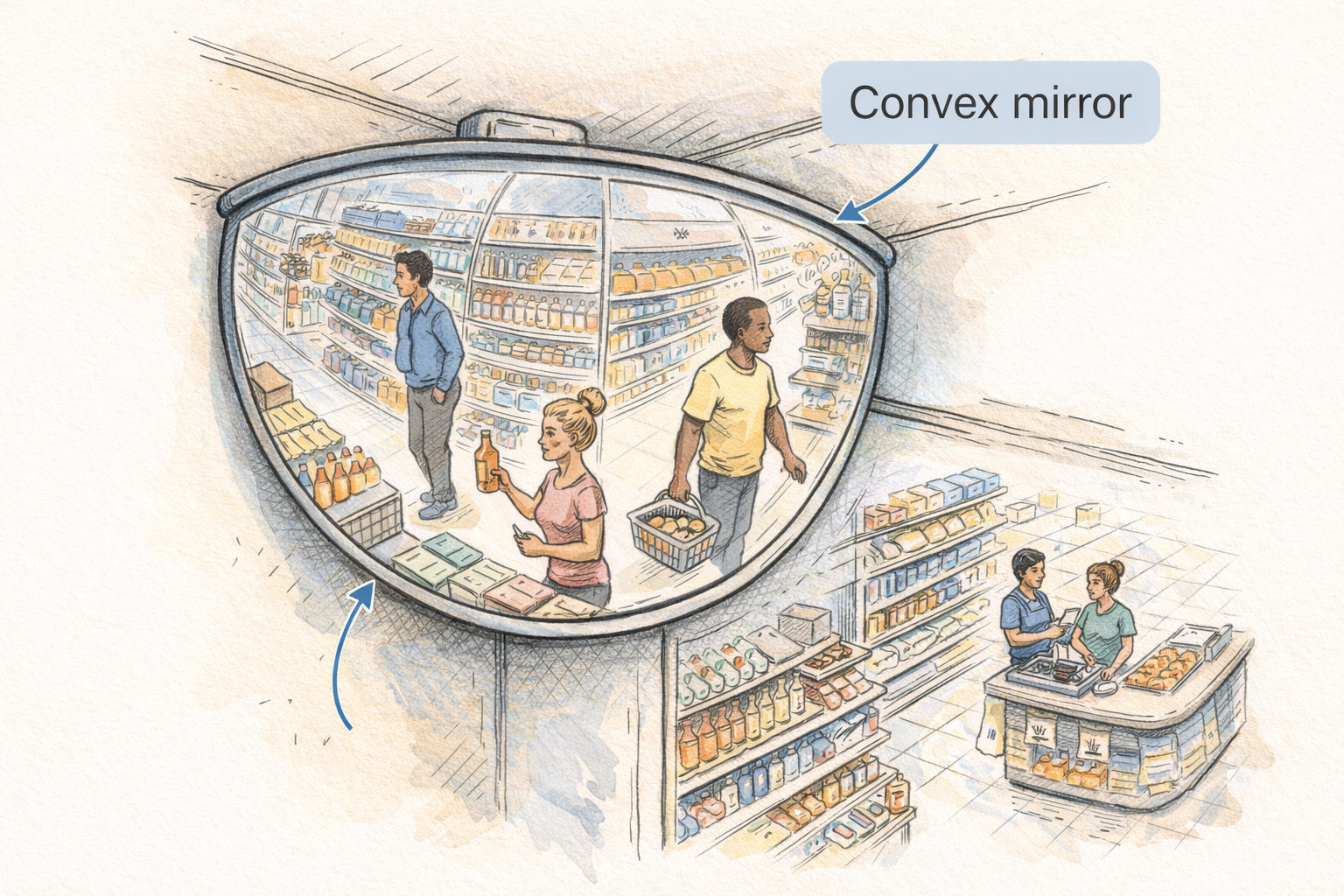
Convex mirrors are used as security mirrors in shops because they provide a wide field of view,
allowing one to see a large area at once!
Types of Curved Mirrors
There are three main types of curved mirrors and reflecting surfaces:
- Concave mirror
- Convex mirror
- Parabolic surface
Each type reflects light differently and therefore produces different types of images.
1. Concave Mirror
A concave mirror is a curved mirror whose reflecting surface curves inward,
similar to the inside of a bowl or spoon.
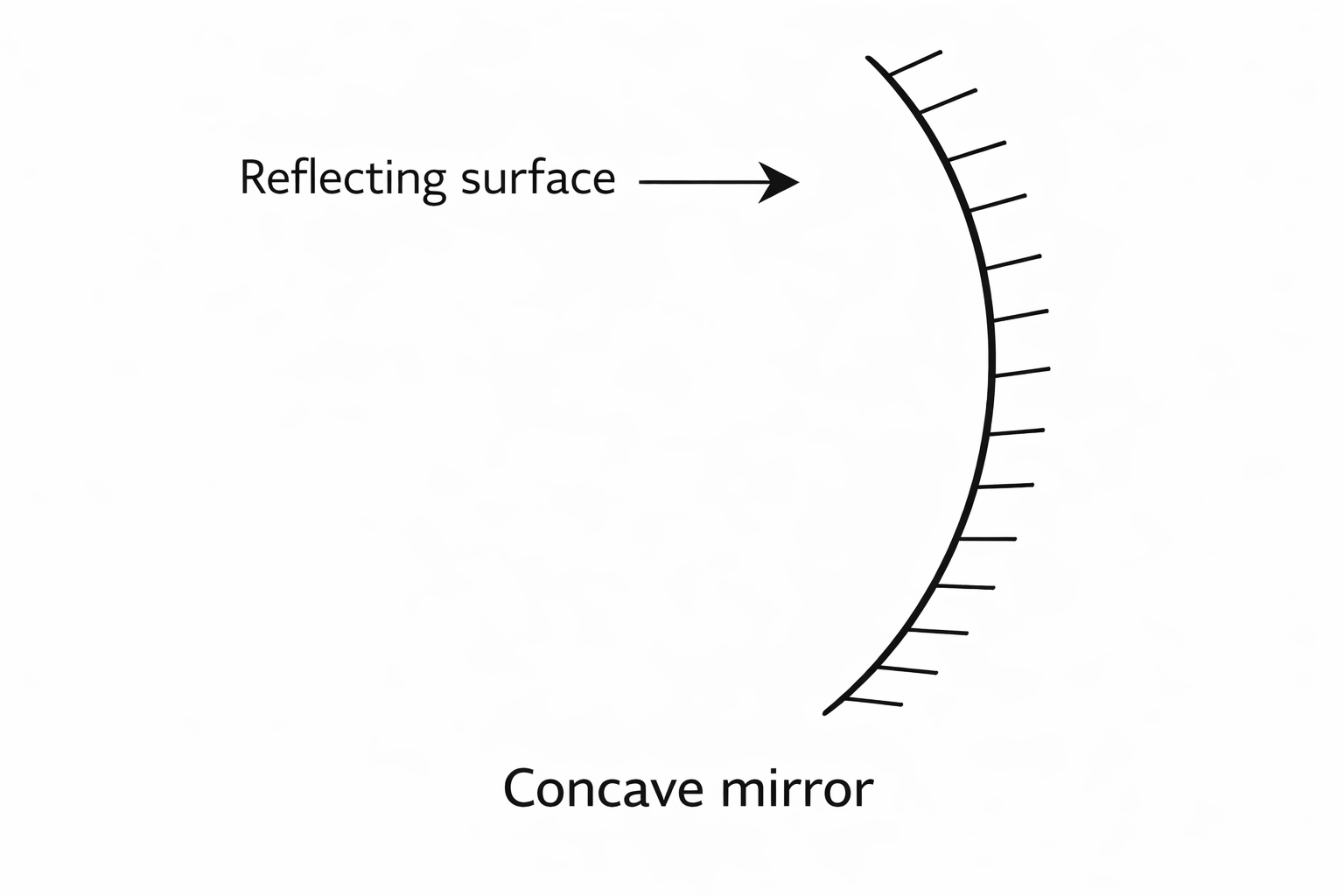
Key Characteristics
- Reflecting surface curves inwards
- Also called a converging mirror
- Causes parallel rays of light to converge at a point
- Can produce real or virtual images
Behaviour of Light
When rays of light that are parallel to the principal axis strike a concave mirror,
they are reflected and meet at a single point called the principal focus.
Image Formation
- Real or virtual images
- Magnified, reduced, or same size
- Upright or inverted
The nature and size of the image depend on the position of the object relative to the mirror.
💡 Did You Know?
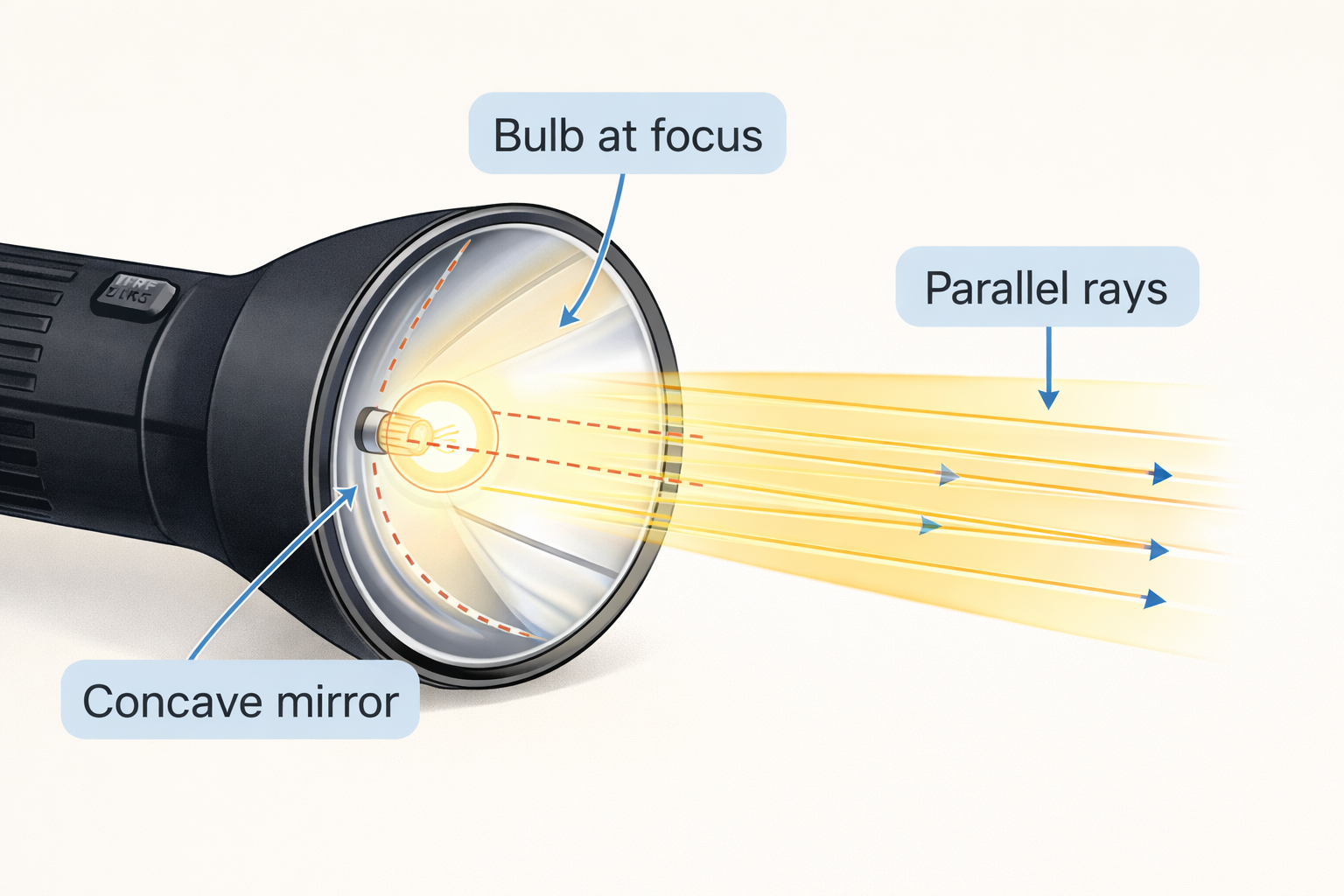
Concave mirrors are used in car headlights to produce powerful parallel beams of light.
2. Convex Mirror
A convex mirror is a curved mirror whose reflecting surface bulges outward.
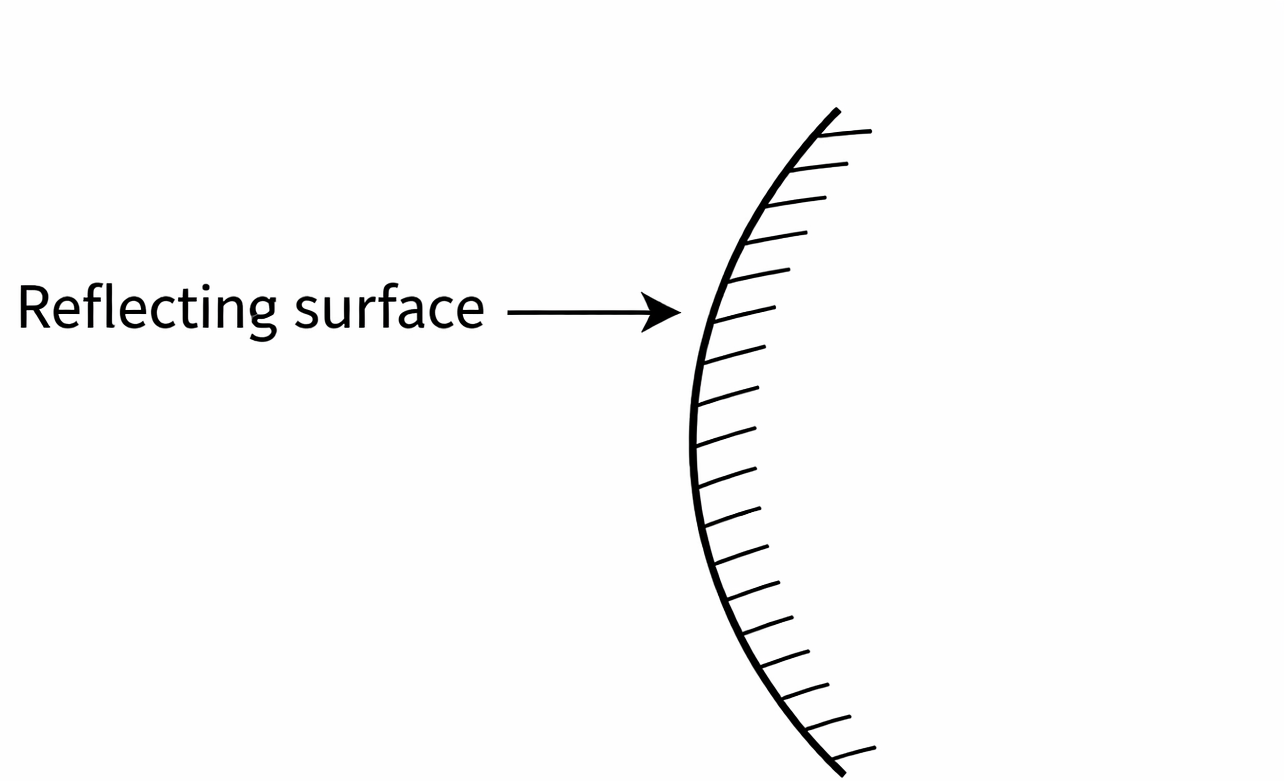
Key Characteristics
- Reflecting surface curves outwards
- Also called a diverging mirror
- Causes reflected rays to spread out
- Always forms virtual images
Behaviour of Light
Parallel rays appear to originate from a point behind the mirror after reflection.
Image Formation
- Virtual
- Upright
- Smaller (diminished)
- Located behind the mirror
This allows convex mirrors to provide a wide field of view.
3. Parabolic Surfaces
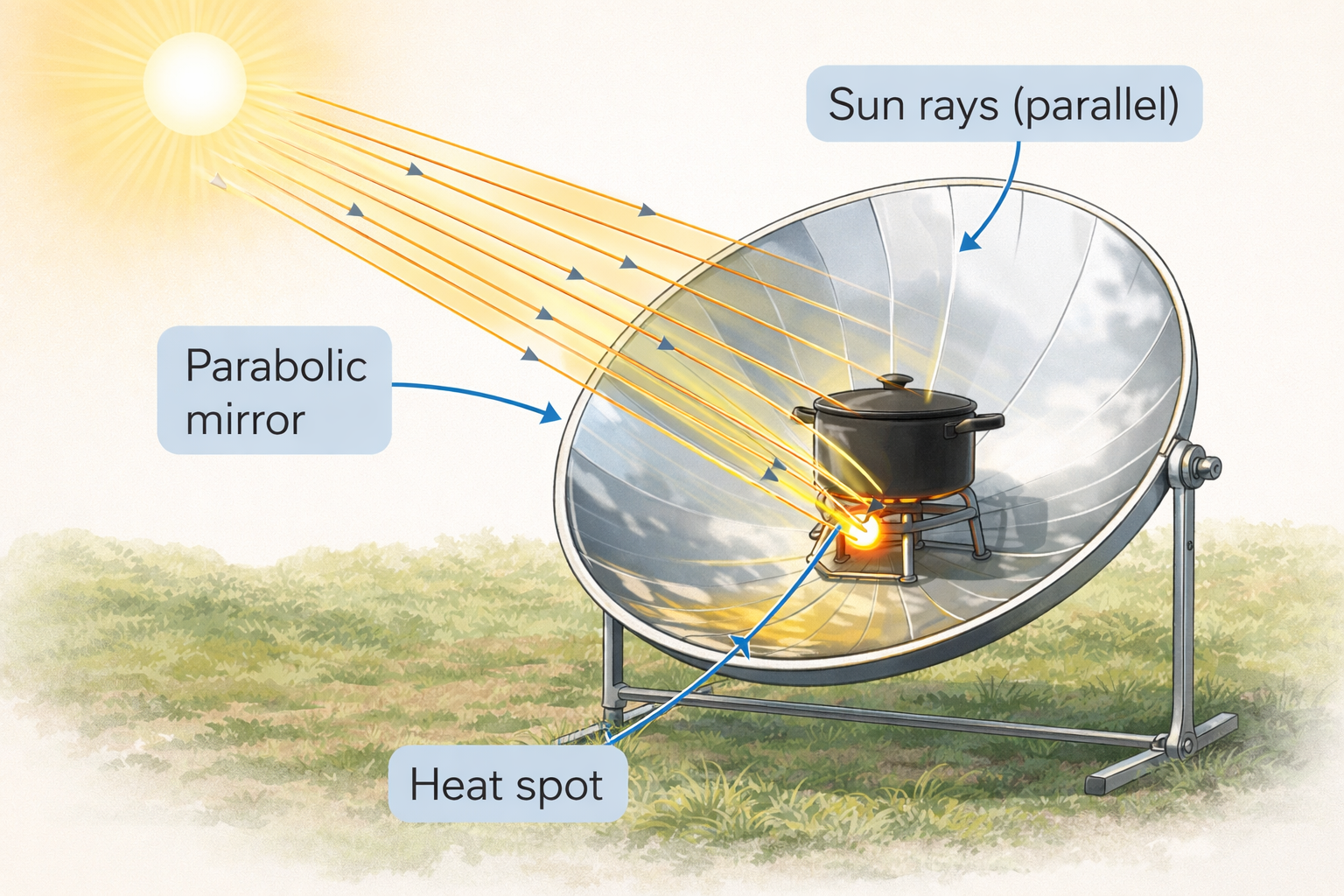
A parabolic surface ensures all parallel rays meet at one focal point.
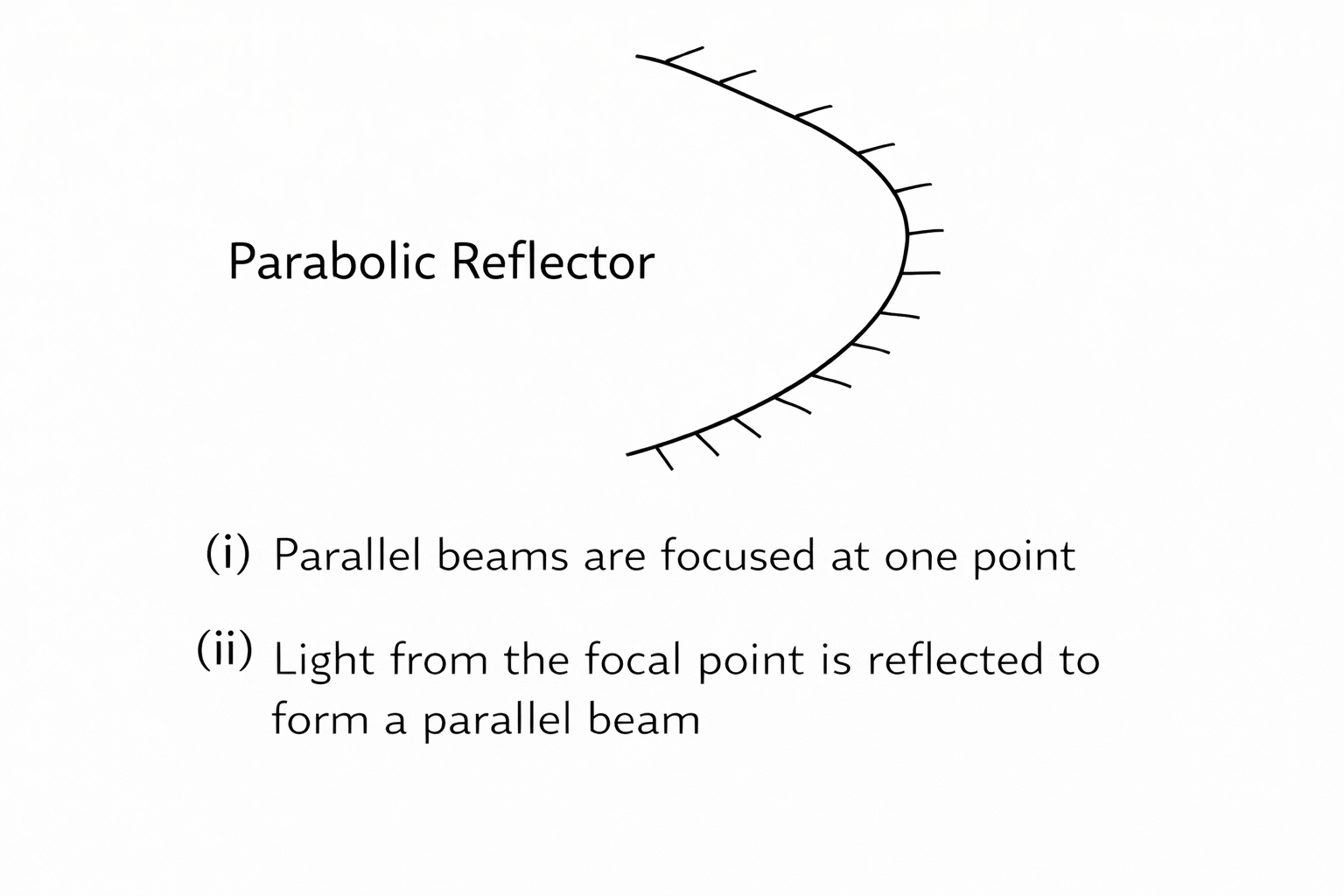
Properties
- Parallel rays meet at the focus
- Rays from the focus become parallel
- Efficient focusing of light
Applications
- Searchlights
- Solar cookers
- Reflecting telescopes
- Satellite dishes
🔍 Did You Know?
Satellite dishes use parabolic mirrors to focus signals precisely onto receivers.
Terms Used in Curved Mirrors
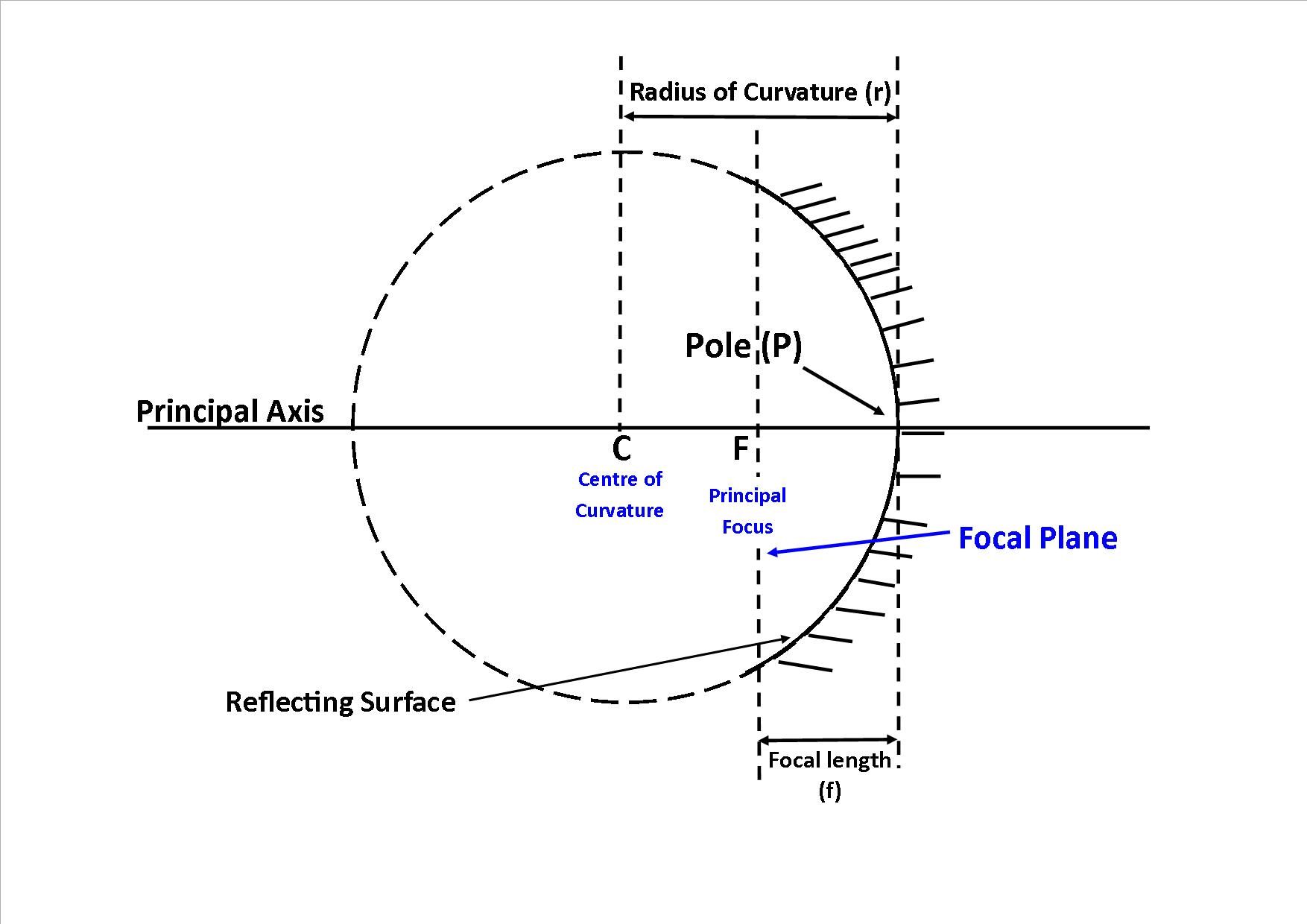
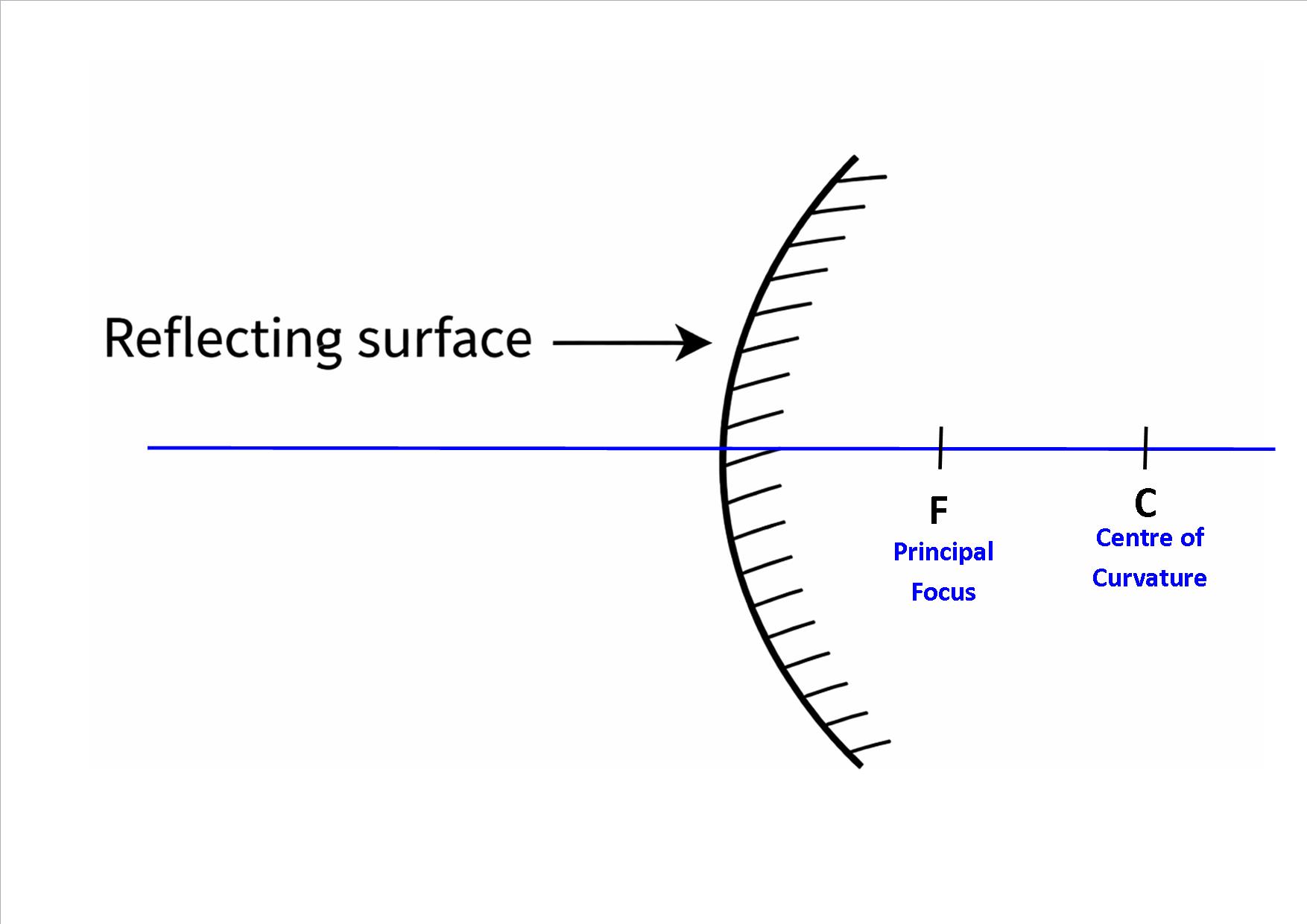
i) Pole (P)
The central point of the mirror.
ii) Centre of Curvature (C)
The centre of the sphere from which the mirror is formed.
iii) Position of C
- Concave: in front
- Convex: behind
iv) Radius of Curvature (R)
Distance between pole (P) and centre of curvature (C).
R = PC
v) Principal Axis
Straight line through P and C.
vi) Principal Focus (F)
Point where rays meet or appear to meet.
vii) Focal Length (f)
Distance between pole and focus.
f = R / 2
viii) Incident Ray
Ray striking the mirror.
ix) Reflected Ray
Ray leaving the mirror.
x) Aperture
Width of the mirror.
xi) Focal Plane
Plane passing through focus.
Experiment: Determining the Focal Length
Apparatus
- Concave mirror
- Metre rule
- Screen
- Mirror holder
- Distant object
Procedure
- Face mirror toward distant object
- Place screen in front
- Move screen until sharp image forms
- Measure distance
This distance is the focal length.
Observations
- Image is real and inverted
- Image forms at focus
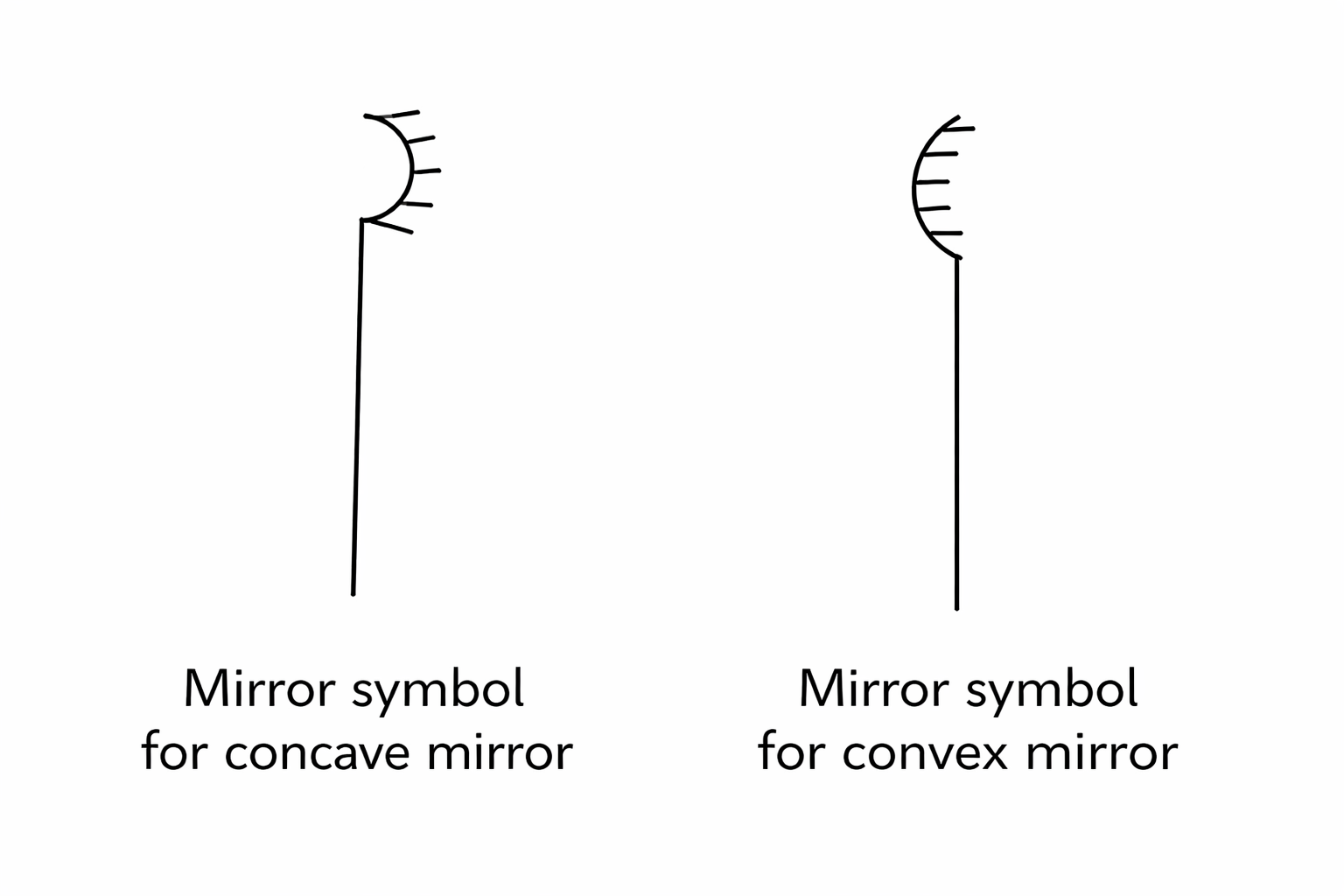
When drawing ray diagrams, we reprent mirrors using symbols as shown below:
Reflection of Rays in Curved Mirrors
Rules of Drawing ray diagrams
Certain rays behave in predictable ways when they strike curved mirrors.
These rules are used when drawing ray diagrams.
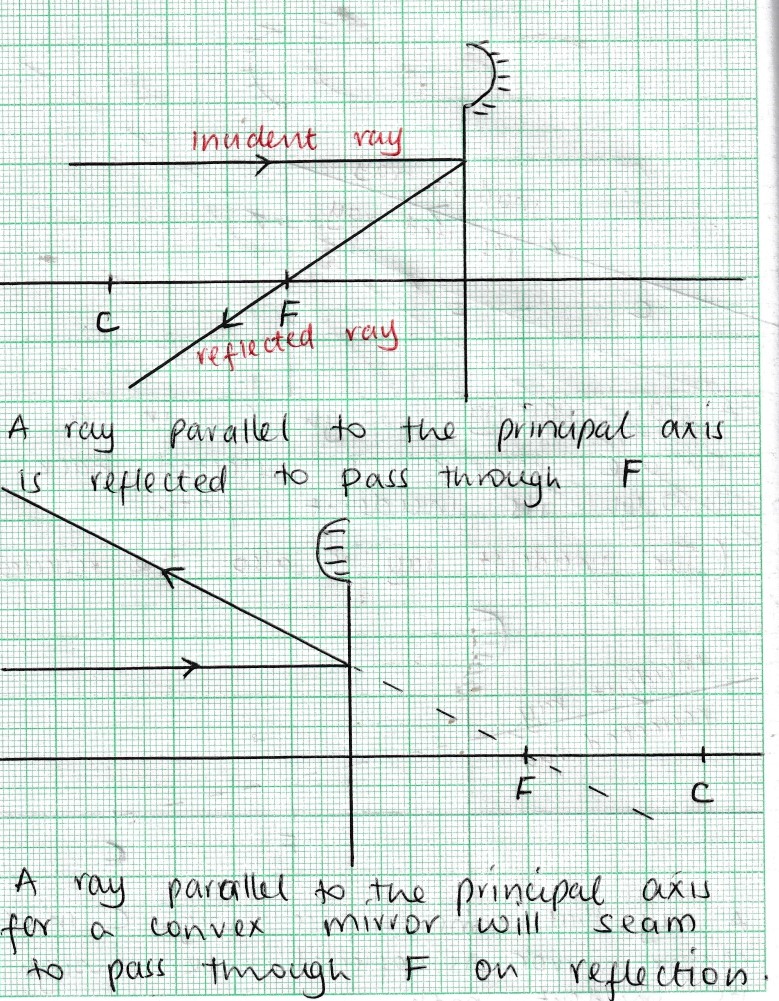
1. Ray Parallel to the Principal Axis
Concave mirror:
A ray parallel to the principal axis is reflected through the principal focus (F).
Convex mirror:
A ray parallel to the principal axis is reflected and appears to originate
from the principal focus behind the mirror.
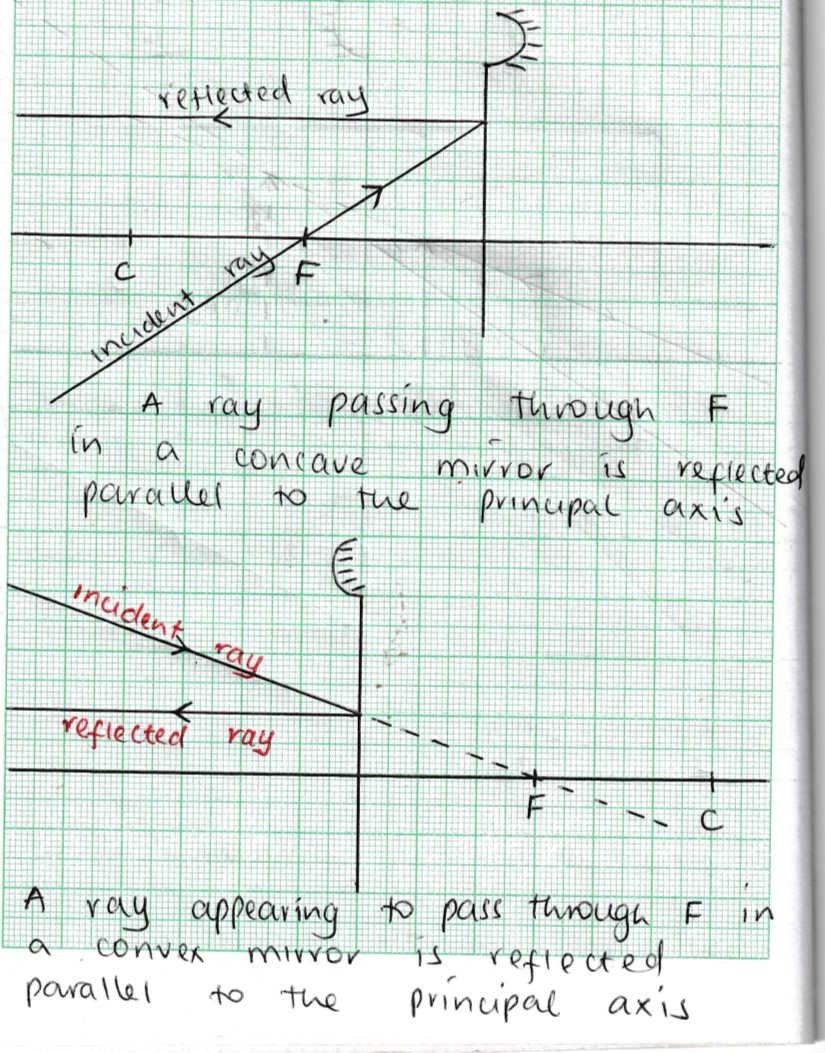
2. Ray Passing Through the Principal Focus
For a concave mirror, a ray passing through the principal focus (F)
is reflected parallel to the principal axis.
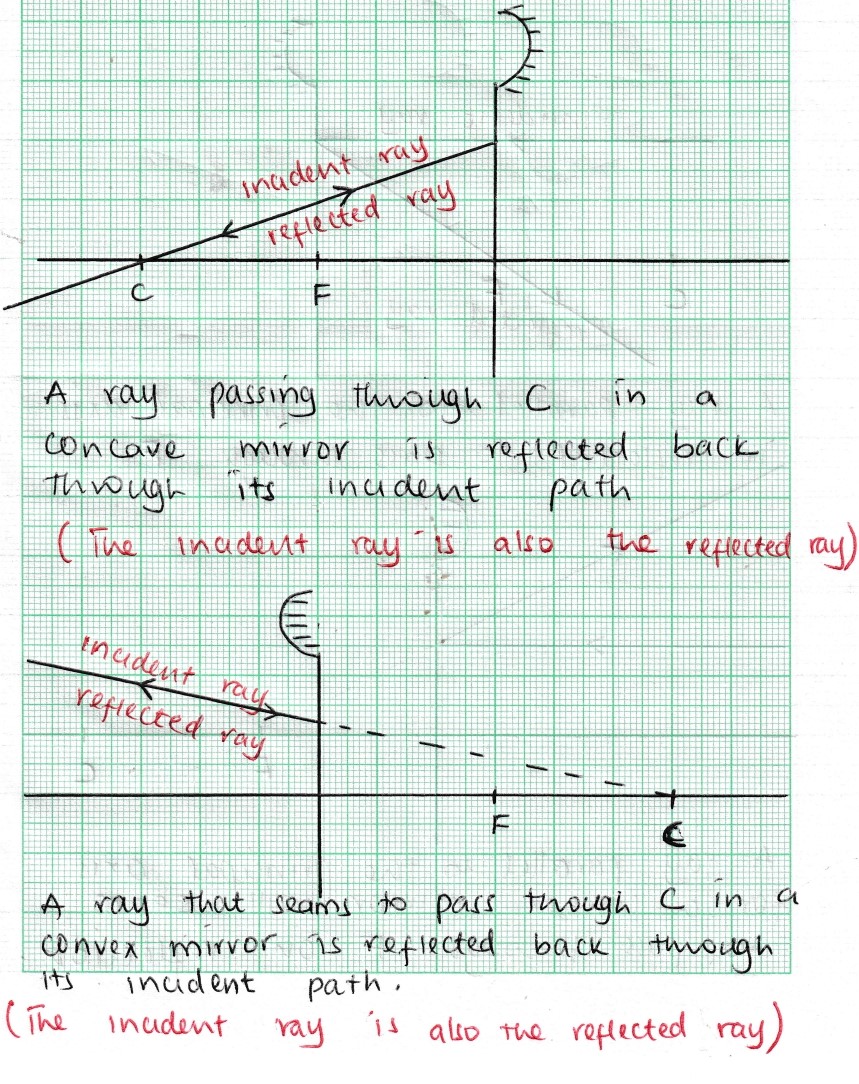
3. Ray Passing Through the Centre of Curvature
A ray passing through the centre of curvature (C) strikes the mirror
perpendicularly and is reflected back along the same path.
4. Ray Striking the Pole
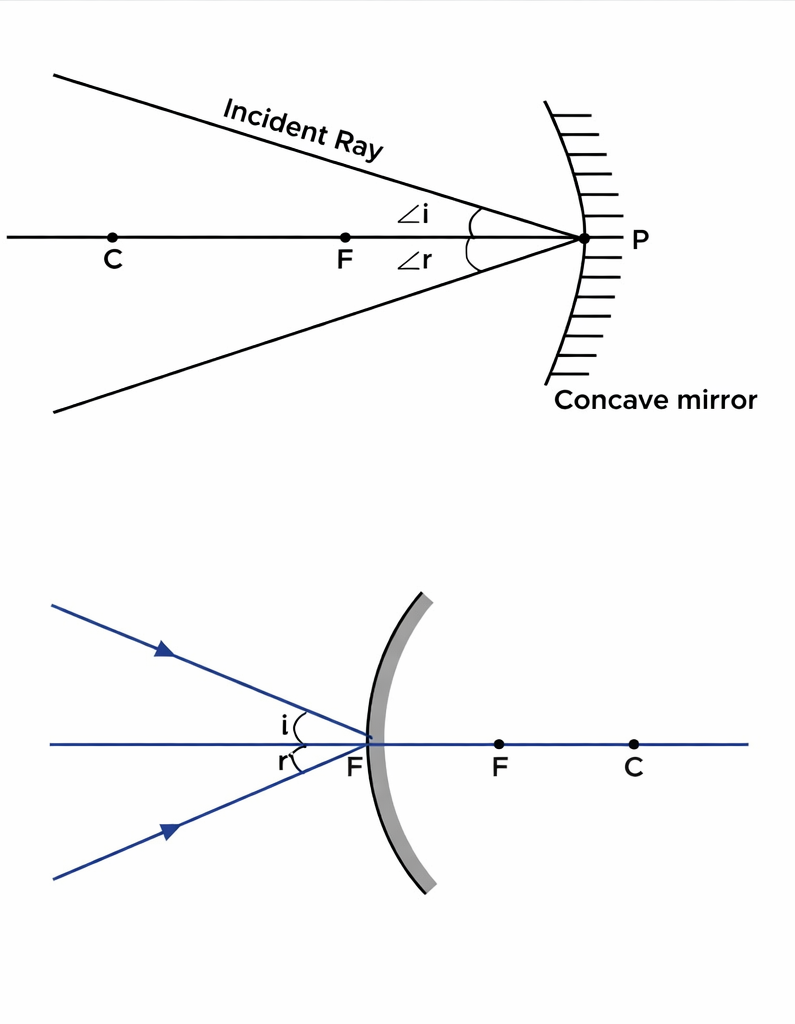
A ray striking the pole (P) obeys the law of reflection.
Angle of incidence = Angle of reflection
Image Formation by Concave Mirrors
The type of image formed by a concave mirror depends on the position
of the object relative to the mirror.
Object at infinity (very far away)
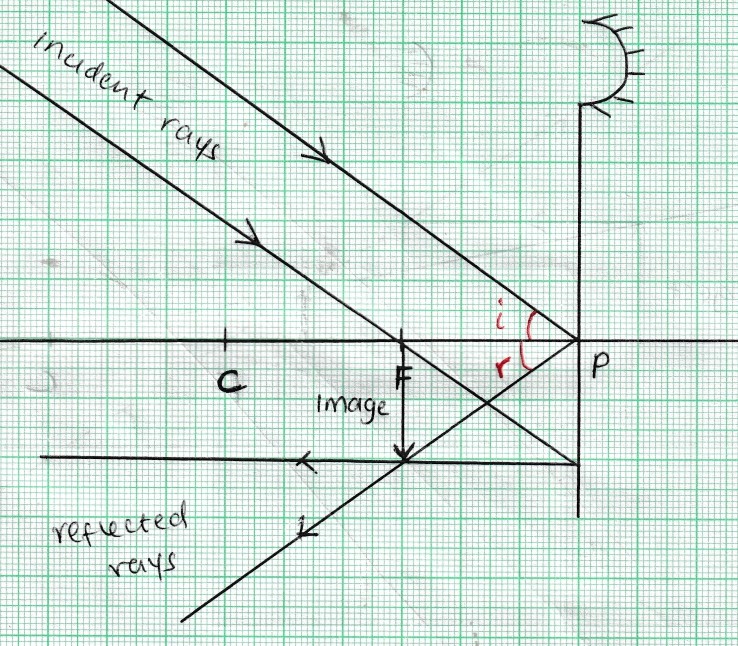
The image formed is:
- Formed at F
- Real
- Inverted
- Smaller than the object
Object beyond C
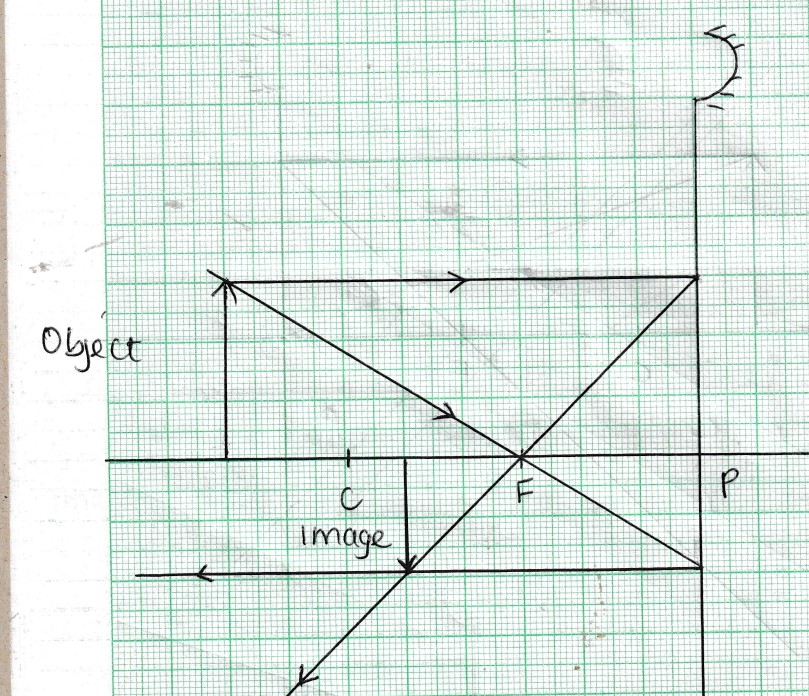
The image formed is:
- Formed between F and C
- Real
- Inverted
- Smaller than the object
Object at C
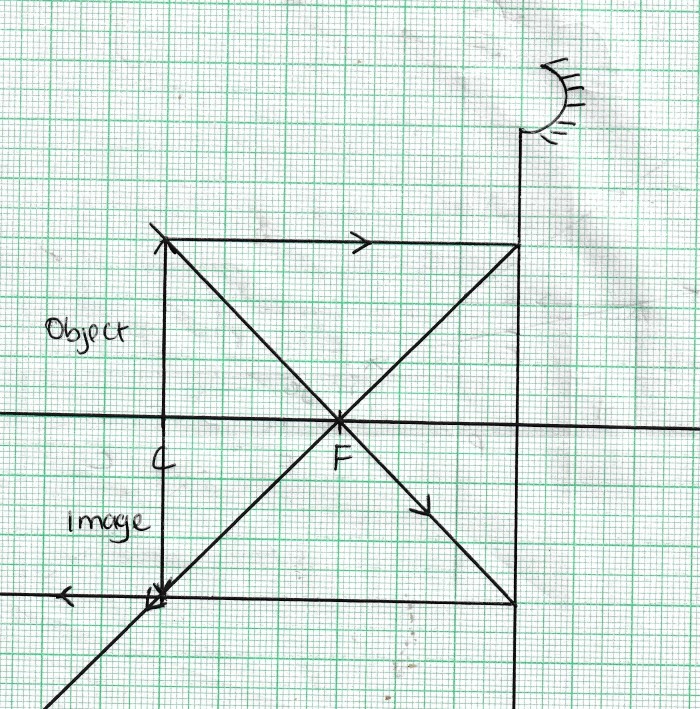
The image formed is:
- Formed at C
- Real
- Inverted
- Same size as the object
Object between C and F
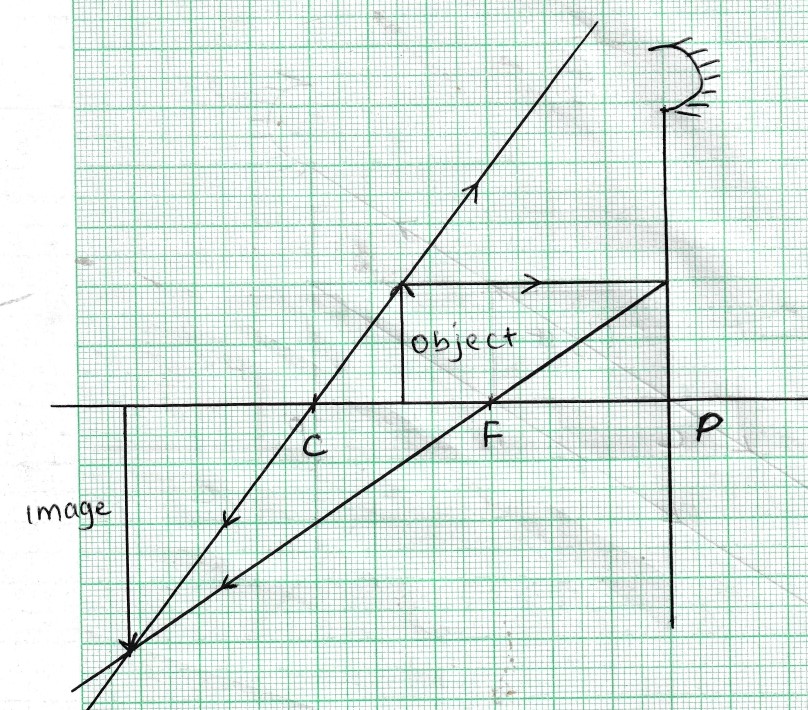
The image formed is:
- Formed beyond C
- Real
- Inverted
- Larger than the object
Object at F
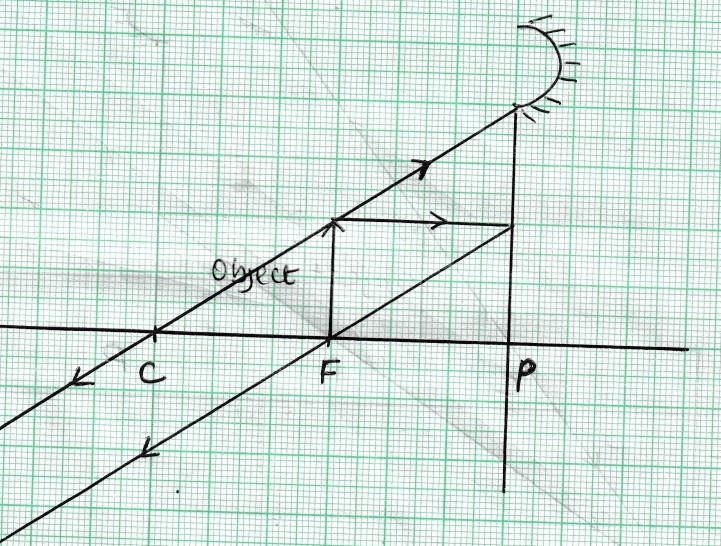
The image formed is:
- Formed at infinity
- Real
- Inverted
- Larger than the object
- Formed behind the mirror
- Virtual
- Upright
- Larger than the object
- Virtual
- Upright
- Smaller than the object
- Real
- Inverted
- Very small
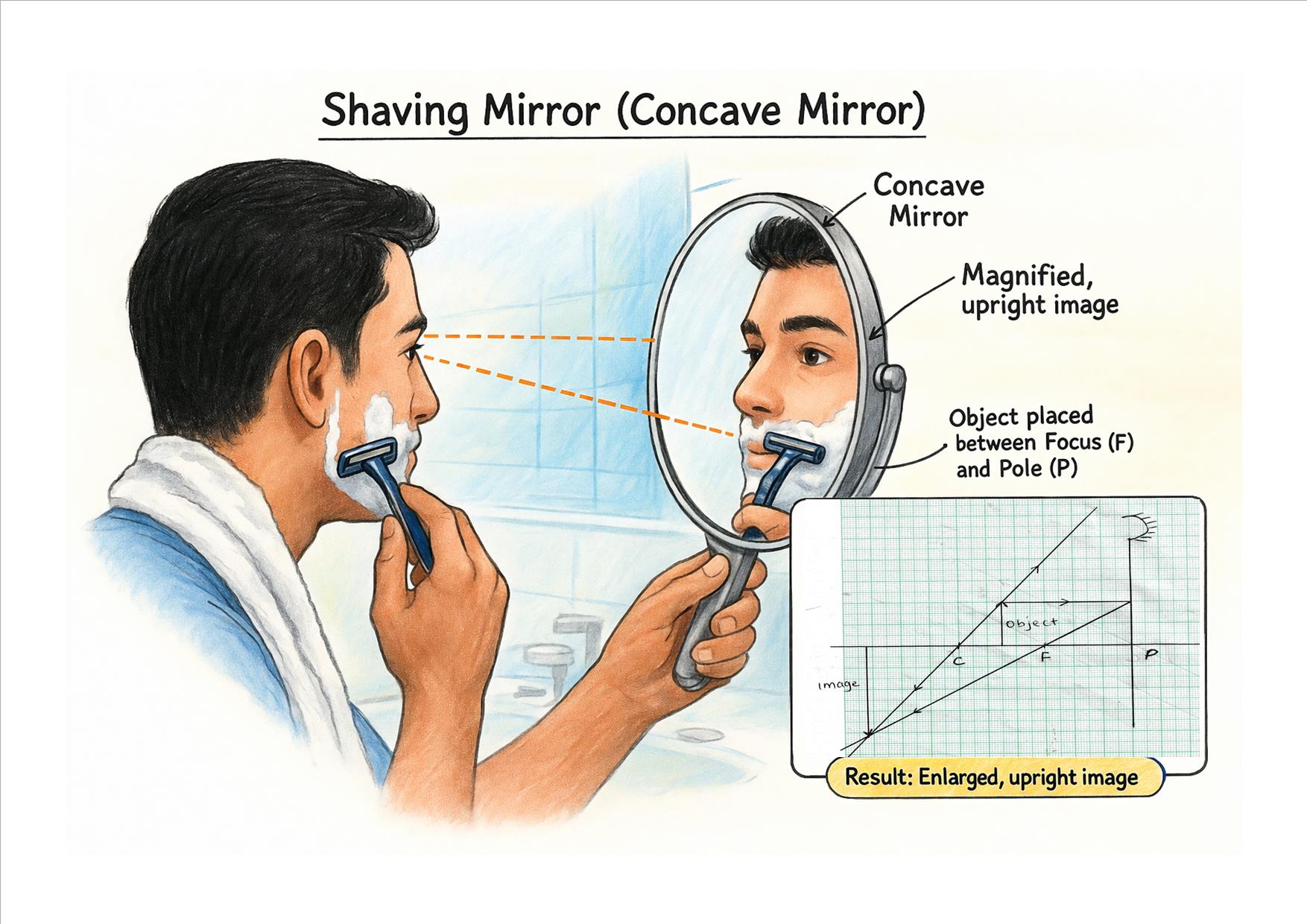
- Shaving mirrors
Used to obtain a magnified image of the face. - Dentist mirrors
Provide a magnified view of teeth and gums. - Torches and flashlights
The bulb is placed at the focus of a concave reflector, producing a parallel beam of light. - Vehicle headlights
Concave reflectors produce strong forward beams of light. - Solar cookers
Concave mirrors concentrate sunlight to generate heat energy for cooking. - Microscopes
Used to focus light onto specimens. - Telescopes
Used to collect and focus light from distant objects. - Vehicle side mirrors
Provide a wide field of view, allowing drivers to see more area behind the vehicle. - Security mirrors
Used in shops and supermarkets to monitor large areas. - Road safety mirrors
Installed at blind corners and parking areas. - Inspection mirrors
Used by security personnel to inspect under vehicles. - Curved mirrors have a curved reflecting surface unlike plane mirrors.
- They follow the law of reflection.
- They can converge or diverge light rays.
- They form real or virtual images of different sizes.
- Concave mirrors (converging mirrors).
- Convex mirrors (diverging mirrors).
- Parabolic surfaces for efficient focusing.
- Each type produces different image characteristics.
- Reflecting surface curves inward.
- Parallel rays converge at the principal focus.
- Can form real or virtual images.
- Images may be magnified, reduced, upright or inverted.
- Reflecting surface bulges outward.
- Reflected rays diverge.
- Always form virtual, upright images.
- Images are always smaller and behind the mirror.
- Focus parallel rays to a single point.
- Rays from focus become parallel after reflection.
- Provide efficient light focusing.
- Used in telescopes, solar cookers and satellite dishes.
- Pole (P): centre of the mirror surface.
- Centre of curvature (C): centre of the sphere.
- Radius of curvature (R): distance PC.
- Principal axis: line through P and C.
- Principal focus (F): point where rays meet.
- Focal length (f): distance PF, where f = R/2.
- Parallel rays reflect through the focus (concave).
- Rays through focus reflect parallel to axis.
- Rays through centre of curvature reflect back.
- At pole: angle of incidence = angle of reflection.
- Beyond C: real, inverted, smaller.
- At C: real, inverted, same size.
- Between C and F: real, inverted, magnified.
- At F: image at infinity.
- Between F and P: virtual, upright, magnified.
- Image always formed behind the mirror.
- Always virtual and upright.
- Always smaller than the object.
- Position is between pole (P) and focus (F).
- Light rays are nearly parallel.
- Concave mirror forms image at focus.
- Image is real and inverted.
- Image is very small.
- Shaving and dentist mirrors.
- Torches and vehicle headlights.
- Solar cookers.
- Microscopes and telescopes.
- Vehicle side mirrors.
- Security and surveillance mirrors.
- Road safety mirrors.
- Inspection mirrors.
- Use a concave mirror and distant object.
- Adjust screen until sharp image forms.
- Measure mirror to screen distance.
- This distance equals focal length.
Object between C and F
The image formed is:
Summary of Images Formed by Concave Mirror
| Object Position | Image Position | Nature | Orientation | Size |
|---|---|---|---|---|
| Vey Far Away | At F | Real | Inverted | Smaller |
| Beyond C | Between C and F | Real | Inverted | Smaller |
| At C | At C | Real | Inverted | Same size |
| Between C and F | Beyond C | Real | Inverted | Magnified |
| At F | At infinity | Real (Image not Clearly Visible) | Inverted | Highly enlarged |
| Between F and P | Behind the mirror | Virtual | Upright | Magnified |
Image Formation by Convex Mirrors
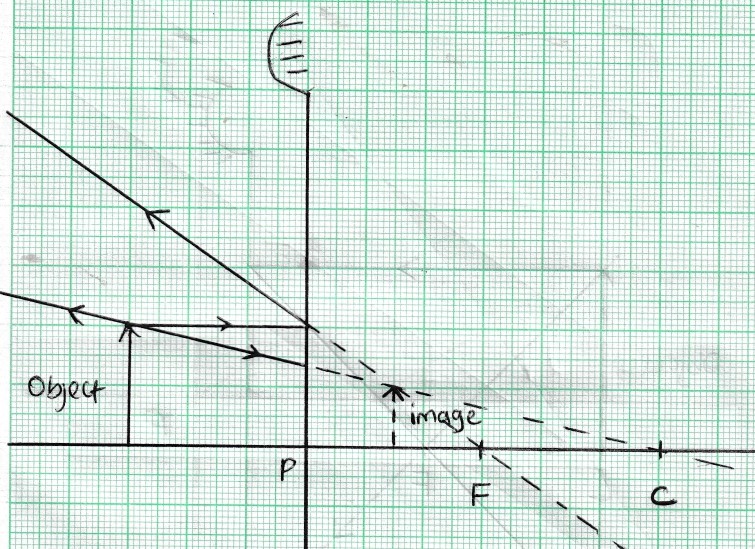
For all object positions, convex mirrors always produce images with the following properties:
The image is always formed behind the mirror, between the pole (P) and the focus (F).
Explanation on Images Formed by Distant Objects in a Concave Mirror
When the object is very far away, the light rays reaching the mirror are almost parallel.
For a concave mirror:
Parallel rays converge at the focus (F).
Image Characteristics
Applications of Curved Mirrors
Uses of Curved Mirrors in Daily Life
Uses of Concave Mirrors
🔬 Did You Know?
Concave mirrors are used in telescopes to collect faint light from distant stars and form clear images.
💡 Did You Know?
Concave mirrors can produce both real and virtual images, which makes them extremely useful in scientific instruments.
Uses of Convex Mirrors

🚗 Did You Know?
The warning “Objects in mirror are closer than they appear” is used on convex mirrors because they produce smaller images.
Summary
Curved Mirrors
Types of Curved Mirrors
Concave Mirrors
Convex Mirrors
Parabolic Surfaces
Key Terms
Ray Diagram Rules
Concave Mirror Images
Convex Mirror Images
Images of Distant Objects
Uses of Concave Mirrors
Uses of Convex Mirrors
Experiment (Focal Length)
Curved Mirrors Assessment
Answer all 22 questions on curved mirrors.
22 Questions
🔎 Grade 9 Integrated Science Navigator
Structure of Atom
Metals and Alloys
Water Hardness
Nutrition in Plants
Nutrition in Animals
Reproduction in Plants
Interdependence of Life
Curved Mirrors
Waves